


Latest news

Barracuda Networks incorporated MSPs into its previously reseller-only partner success program in March and announced last month new support including channel marketing automation, co-marketing resources, account mapping, customer propensity data, and an upcoming partner locator website. This adjustment reflects the diversification of customer purchasing methods and the adaptive changes of IT service partners.

Nvidia reported Q2 fiscal year 2027 revenue of $96.2 billion, doubling year-over-year, but executives warned that memory supply bottlenecks may persist until the end of fiscal year 2028. Data center business revenue reached $89 billion, with hyperscale customers contributing $49 billion. CFO Colette Kress stated that the company is collaborating with three major memory suppliers to expand capacity, and CEO Jensen Huang expects fiscal year 2028 revenue to grow 70% year-over-year. Analysts noted that enterprises should focus on AI investment returns rather than merely purchasing GPUs.

A WalkMe survey of 2,000 employees released on Tuesday shows that AI is raising workplace performance expectations, but there is a gap between employees' actual application skills and their confidence. One-third of respondents admitted to exaggerating their AI skills, and another third passed off AI-generated content as original. Gen Z has the highest confidence but also the highest rate of exaggeration, while Baby Boomers show the opposite.
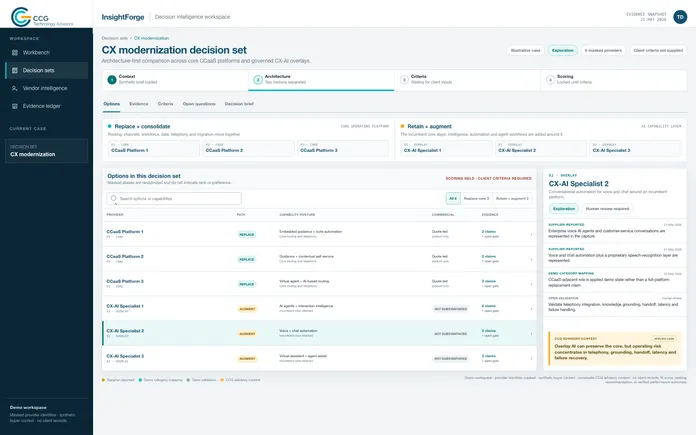
Cloud Communications Group will launch its decision intelligence platform InsightForge next month, digitizing 19 years of consulting history data to address the complexities of committee-based procurement. The platform is free, LLM-agnostic, and designed to provide full lifecycle visibility to procurement committees while mitigating knowledge gaps caused by CIO turnover.

Infosys' latest report shows that corporate enthusiasm for AI investment remains strong, but 72% of respondents have successfully scaled fewer than a quarter of pilots, and two-thirds of enterprises struggle to measure AI ROI. Experts point out that team coordination and business-oriented definitions of success are key.

Agentic AI is reshaping customer behavior much like e-commerce did years ago, but it also risks brands losing control over the customer journey. This article explores the resulting issues of data, trust, and ownership, as well as how enterprises can address these challenges by becoming merchants of record, establishing dedicated agents, and more.

As AI adoption becomes a top technology priority for enterprises, the IT services industry is facing a turning point. A survey commissioned by Corsica Technologies and conducted by Censuswide among 600 IT and security decision-makers reveals that although 87% of respondents are satisfied with the guidance provided by their MSPs, only 35% fully trust their MSP, and nearly two-thirds are considering switching providers within 12 months. Corsica CEO Brian Harmison points out that customer needs have shifted from response time and uptime to strategic issues such as risk reduction, effective data utilization, and AI readiness, and traditional managed IT contract models are struggling to cover these new responsibilities.

In a blog post on Wednesday, Google said it will provide enterprises with new ways to manage AI costs by expanding flexible billing options, AI agent cost controls, and including developer platforms in the Gemini Enterprise subscription.

Enterprises are accelerating the deployment of AI agents, but the associated security risks and governance challenges are also expanding. Analysts at Gartner, Forrester, and other institutions point out that security responsibility is shifting from the CISO to cross-organizational sharing, and governance and security need to be treated separately and reviewed periodically.

Walmart's Chief People Officer, Donna Morris, revealed at the MIT Technology Review EmTech AI Summit that the company plans to provide AI skills training to 2.1 million employees over the next few years, covering all roles from technical teams to store greeters. Currently, AI certifications for 1.7 million employees in the U.S. and Canada are now available, with training aimed at integrating agentic AI into employee workflows to reduce friction and enhance customer experience. Morris emphasized that AI adoption has not led to job reductions, with the company's workforce size remaining the same as six years ago, while revenue has grown significantly.