


Latest news
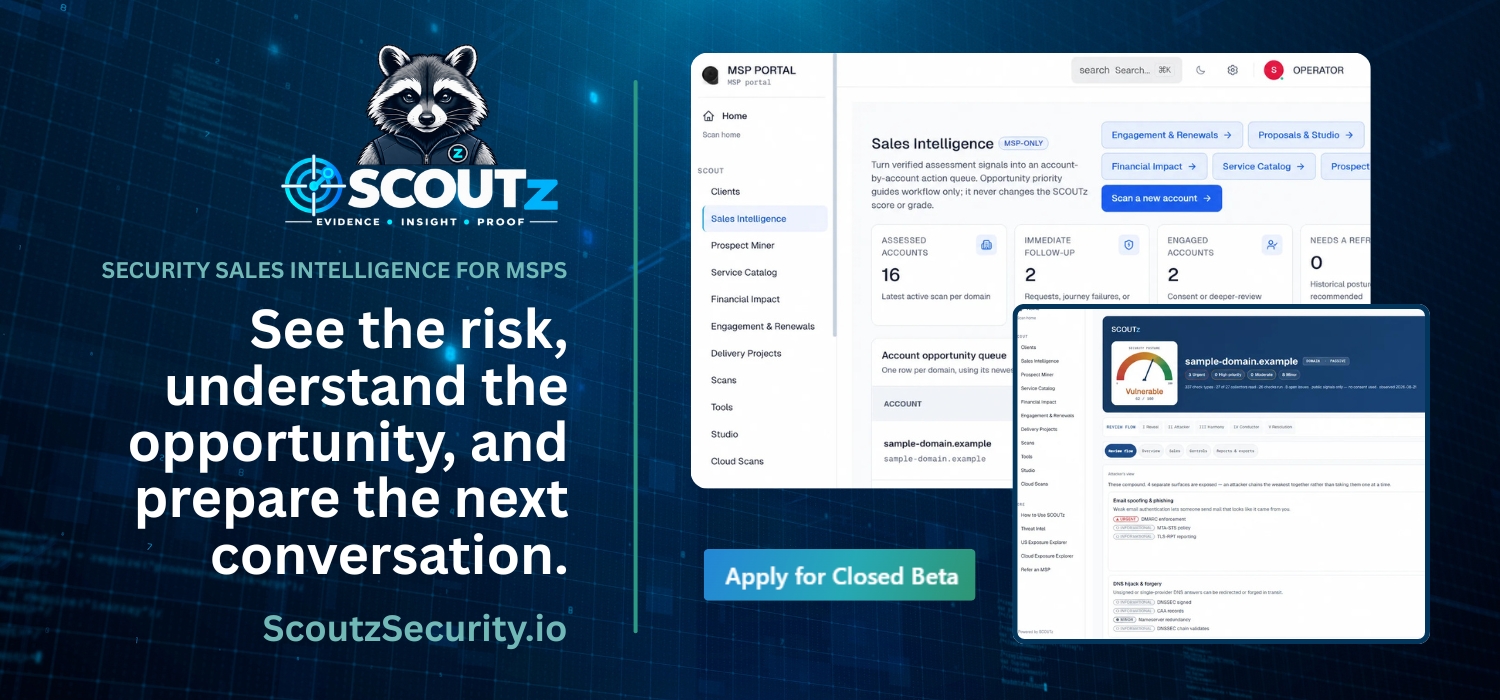
SCOUTz has launched an open beta of its prospect intelligence platform designed for MSP security sales. The platform provides MSPs with dated external evidence about a prospect's environment before meetings, including domain reviews with 156 checks and optional read-only Microsoft 365 configuration reviews. It emphasizes evidence-based selling, traces findings to dated checks and named sources, and generates client-safe and operator reports. The open beta offers 30 days free, then $279 per month. Fifty MSPs participated in a closed beta. Founder Steve Copeland emphasizes the platform's deliberate limits: read-only design, no fear-based modeling, and human ownership of final claims.

Newgen Software Technologies Ltd. announced its Q2 FY'27 financial results for the quarter ended September 30, 2026, reporting revenue of ₹422 crore, a 5% YoY increase. Annuity revenue grew 15% to ₹268 crore, SaaS revenue rose 36% to ₹63 crore, and profit after tax increased 6% to ₹87 crore. The company added 9 new enterprise customers, secured 10 AI-based deal bookings in H1 FY'27, and saw growth in EMEA (19.4%) and the Americas (17.1%). Newgen also released NewgenONE AI Studio updates and received recognition for low-code and AI-led innovation.
Informa TechTarget (Nasdaq: TTGT) announced plans to integrate its proprietary Buyer Intelligence solution with Demandbase by Q1 2027. Beginning in January, joint customers will access Informa TechTarget's directly observed, person-level intent data and click-level behavioral insights natively within Demandbase, enabling more sophisticated ABM scoring, prioritization, propensity modeling, buying group identification, account list creation, and multi-channel activation. The integration builds on last year's Informa TechTarget Account Intent Feed data integration. Buyer Intelligence draws from Informa TechTarget's global business and technology decision-maker audience, which generates 1.9 million exclusive intent signals daily. Informa TechTarget has been recognized as a Leader in Forrester Wave™: Intent Data Providers For B2B, Q1 2025, and other industry reports.

At Motivforce's inaugural 'Insights that Move the Channel' executive roundtable, channel leaders from Lenovo, IBM, Equinix and Innovative Networx examined whether AI adoption is delivering better channel performance beyond productivity gains. The discussion highlighted AI's potential to reshape competitive dynamics between large and small partners, the need to rethink traditional partner programs, and the growing importance of partner experience. Motivforce has published an interactive e-book capturing key findings and recommendations for vendors seeking to turn AI investment into measurable commercial value.

IT teams at small and midsize businesses are struggling with oversized security responsibilities, according to a survey of 361 SMB leaders by CyberFox. Nearly two-thirds said limited staffing has left important security risks unaddressed, and almost half reported their most significant known security gap was left open for at least six months. Three-quarters said security responsibilities have grown faster than IT headcount over the past three years. Nearly 4 in 5 respondents at companies with IT teams under 15 people said they had implemented a cybersecurity solution their teams could not fully deploy or manage. Midsize companies are turning to managed security providers to bridge security gaps. Many SMBs use legacy systems and are still working on data modernization and cloud migration, and convincing executives to prioritize AI risk or privileged access management over customer-facing IT work can be difficult. Nearly two-thirds of respondents said they use an MSP or MSSP for at least one IT or cybersecurity function. Organizations with fewer than 15 internal IT employees were almost twice as likely to use an outside provider. More than two-thirds of SMBs using service providers said their provider frequently helped implement a security control the internal team lacked the time or expertise to manage. One in 5 respondents said AI-related initiatives have delayed or deprioritized a planned cybersecurity project, rising to 2 in 5 among IT leaders.

A cohort of financial institutions including Bank of America, Citi, Morgan Stanley, and Blackstone will pour $63 billion into financing AI compute capacity for Anthropic. The partners will buy Broadcom XPU AI accelerators and networking products and lease them to Anthropic starting in 2027. The move comes as AI systems consume massive compute, driving up costs and causing memory shortages. Gartner projects global IT spend to reach $7.35 trillion in 2027, and analysts warn CIOs that current AI costs won't stay low. Other updates include Nvidia and Meta expanding their Muse partnership with a $3 billion equity investment, OpenAI integrating Oracle apps into ChatGPT, IBM extending HashiCorp Vault to AI agents, and Slack making its Code API generally available.
Infosys CEO Salil Parekh said during an earnings call that the Trump administration's crackdown on US employee immigration programs, including the Permanent Labor Certification Program and H-1B visas, will not materially impact the company's costs or attrition. He noted that the majority of Infosys' US workforce are local hires, a shift underway for several years. The Department of Labor suspended Infosys and four other IT firms from the Permanent Labor Certification Program on Oct. 8. Infosys reported $5.1 billion in Q2 FY27 revenue, 1.5% year-over-year growth in constant currency, and revised its FY27 revenue growth guidance to 1-2%. AI made up 10.5% of revenue, and the company won large deals totaling $5.2 billion.

Vida Global has added result-based pricing to its usage-based sales options, charging for approximately 20 specific business outcomes. The move comes after signing an agreement with distributor Avant to shift to an agency sales model and hiring a founding director of channel development. The company's back office capabilities set it apart, but its multi-domain capability constrains partner types. Vida joins a channel where outcome-based models are rare. Industry observers note that while usage-based models are growing, they create revenue variance and complexity, reminiscent of toll-free calling. Tech advisors see opportunities to help CIOs predict spend but caution about risks if vendors lack proper back office infrastructure. If customers demand these models, TAs hope vendors will follow.
Cisco announced updates to its Cisco 360 partner program at its annual partner summit in Vancouver, including expanded recognition paths for advisors and developer partners, a 50% increase in rewards for annual contract value growth, double incentive rates on adopt for all use cases, and new partner value indexes. A distributor value index will be available in spring 2027. The program, introduced in January, replaces legacy frameworks with an outcome-based model for AI adoption. Cisco also added deal registration visibility and eligibility tracking to its partner experience platform. The update follows a year of AI-focused acquisitions and the general availability of Cisco IQ, which gives partners visibility into customer IT estates.

Internet service provider associations USTelecom, NCTA and INCOMPAS, joined by the Technology Channel Sales Professionals trade association, have urged the FCC to exempt sales agents, value-added resellers and dealers from the obligations of an E-Rate consultant. The FCC is seeking comments on its proposed rulemaking for the E-Rate program, which helps schools and libraries afford technology services. The agency wants to define a consultant as a non-employee helping an organization participate in E-Rate and is looking for reasons to exclude channel partners. If lumped into the consultant category, agents would face registration, certification and fee restrictions and lose the ability to earn vendor sales commissions. Reply comments are due November 12, and the outcome could determine whether agents keep earning commissions on E-Rate deals.